
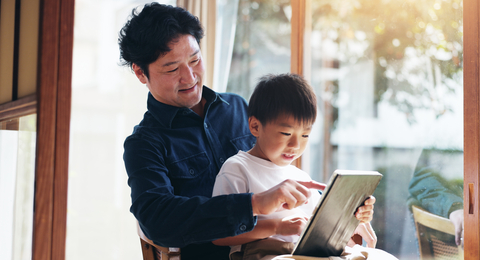
Let's start with the thing nobody says out loud: almost every parent of a toddler uses screens sometimes. And almost every parent of a toddler feels at least a little guilty about it.
The screen time conversation has become so loaded that many parents feel like they're failing no matter what they do. Too much screen time? Bad parent. No screen time at all? Unrealistic — and honestly, there are moments when you need ten minutes to make dinner.
Here's a more useful way to think about it: instead of counting minutes, think about what's happening during those minutes.
Not All Screen Time Is the Same
Pediatricians and child development researchers increasingly distinguish between passive screen time and active screen time. They're very different experiences for your child's brain.
Passive screen time is what it sounds like: your child watches, but doesn't really participate. Autoplay YouTube videos, alphabet songs on repeat, or apps where they just tap randomly to see what happens. The child isn't making decisions, connecting ideas, or being asked to think. It's entertainment, and there's a place for that — but it's not learning.
Active screen time asks your child to engage. They're making choices, responding to questions, connecting what they see on screen to something they understand. When a learning app asks "Which letter is this?" and your child has to look, think, and tap — that's active. When the content on screen relates to their actual life, the engagement goes deeper.
What Makes an Alphabet App Actually Educational?
There are hundreds of alphabet apps available, and most of them are fine. They show letters, play sounds, and reward taps with animations. But "fine" doesn't mean effective. Here's what separates an app that genuinely teaches from one that just keeps your child busy:
It requires your child to respond, not just watch. If your toddler can hold the phone upside down and the app still moves forward, it's not really teaching anything. Good learning apps pause and wait for the child to engage.
It connects to something real. An animated apple is cute but forgettable. A photo of someone your child recognizes creates an emotional anchor that strengthens memory. This is why personalized content outperforms generic content in early learning research.
It adapts to your child's level. An app that cycles through A-Z the same way every time isn't responding to your child. One that notices your child knows the letter S but struggles with the letter R — and adjusts accordingly — is doing something much more valuable.
It doesn't overstimulate. Flashing animations, rapid scene changes, and constant sound effects might hold attention, but they train a child to expect that level of stimulation. The best educational tools are engaging without being frantic.
The Privacy Question Parents Should Ask
There's another angle to the screen time question that doesn't get enough attention: what's happening with your child's data? Many free alphabet apps make money through advertising and data collection. If an app is free and full of ads, your toddler is the product.
When you're evaluating a learning app, it's worth asking: does this app upload photos or data to a server? Does it show ads to my child? Does it track behavior for marketing purposes? These aren't paranoid questions — they're reasonable ones for any parent to ask about software their toddler uses.
Intentional Screen Time With Emotional Connection
The best way to think about educational screen time isn't "is this OK?" — it's "is this doing something my child can't get from a generic toy?"
When your child opens an app and sees Daddy's face next to the letter D, that's not just screen time — that's a moment of recognition, connection, and learning happening together. When the app knows your child has mastered the letters in their name and starts introducing new ones at the right pace, that's adaptive learning that a set of flashcards can't provide. And when mastering a letter earns a cheer in a voice made from Grandma's own, that's positive reinforcement that actually means something.
That's what we built MyAlphaPics to be: screen time that's personal, interactive, adaptive, and private. All photos stay on your device. There are no ads. And the content is literally your child's own world — the people and things they already care about.
The Bottom Line
You don't need to eliminate screen time to be a good parent. You need to be intentional about it. A few minutes of active, personalized alphabet learning is worth more than thirty minutes of passively watching letter videos — and there's no reason to feel guilty about giving your child something that's genuinely educational.
MyAlphaPics turns screen time into intentional learning — using your own family photos, adapting to your child's pace, with no ads and no data uploaded to servers. Learn more.